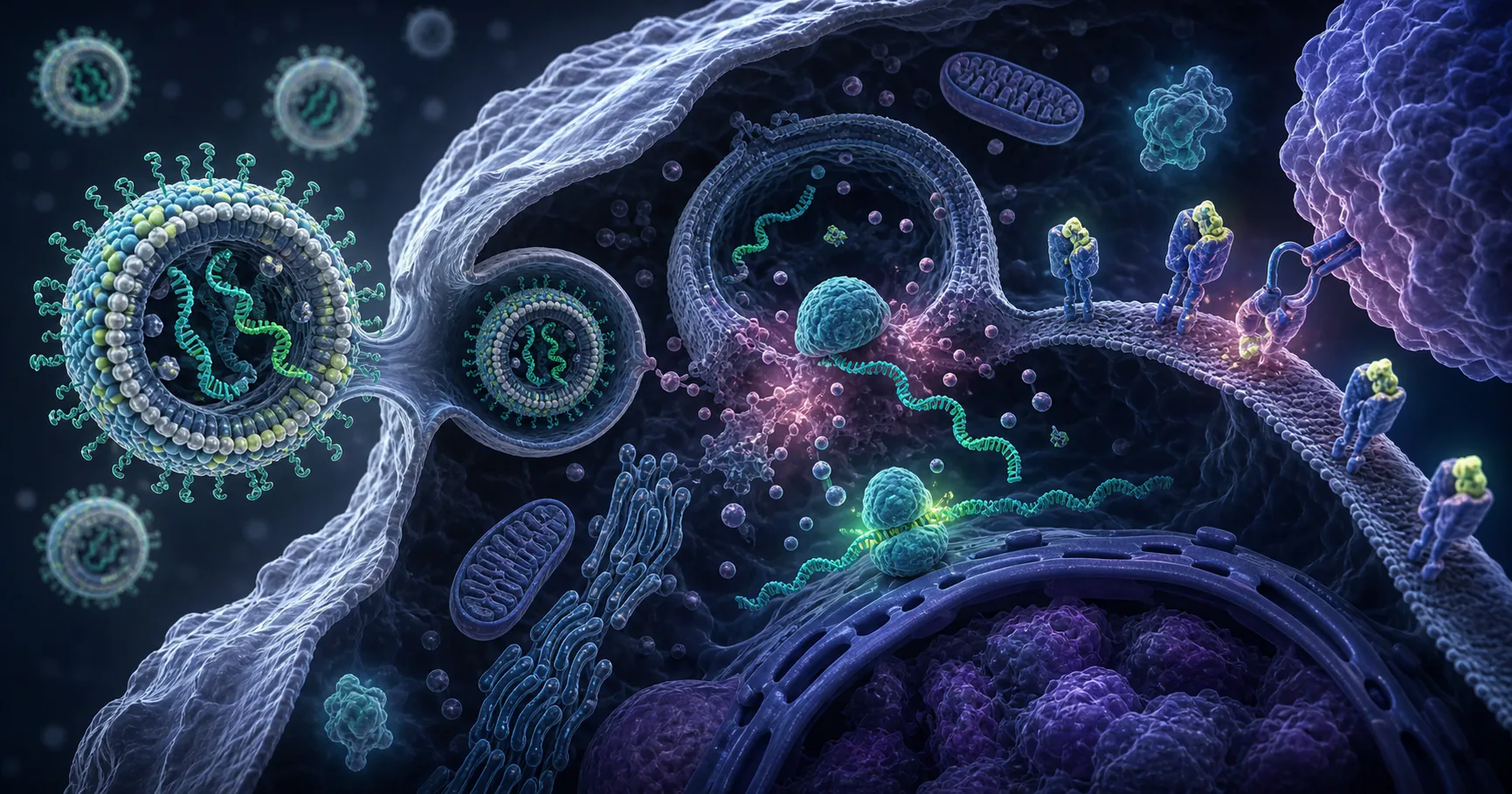
Every personalized neoantigen vaccine is two problems wearing one trench coat. The first — picking which of a patient's tumor mutations to encode — gets most of the attention. The second is quieter and, increasingly, rate-limiting: getting that mRNA payload past the bloodstream, into the right antigen-presenting cells, and across the endosomal membrane intact. That job belongs to the ionizable lipid, the protonatable workhorse at the core of every lipid nanoparticle (LNP). Historically it was found by brute-force combinatorial chemistry — synthesize hundreds of analogs, screen, repeat. In 2024–2025 that loop started to close around computation.
Three threads have matured roughly in parallel. Deep generative models now propose novel ionizable lipids together with a synthesis route, not just a SMILES string that may be unmakeable. Supervised models like LANTERN predict transfection efficiency directly from structure, with reported R² above 0.8 — accurate enough to triage virtual libraries before a flask is touched. And coarse-grained molecular dynamics has progressed to simulating real-size mRNA-LNP self-assembly, exposing where the lipid sits, where the mRNA ends up, and why a given chemistry encapsulates well. For neoantigen vaccines specifically, the most consequential payoff is tissue control: the same design levers that move expression out of the liver and into the spleen are the ones that put antigen where lymphoid priming happens.
Generating Lipids You Can Actually Make
The standout shift is that generative models stopped hallucinating chemistry. A NeurIPS 2024 deep generative model (arXiv:2412.00928) reframes lipid design as building a synthesis directed-acyclic-graph rather than a molecular graph: it adapts the Synthesis-DAG framework, draws building blocks from a pool of ~2.7M ionizable heads and ~15,000 tails mined from commercially available ZINC20 compounds, and swaps in Chemformer (45M parameters) as the reaction predictor. The output is a lipid plus the route to make it. On 14,148 generated samples it hit a 92.6% lipid rate and an 83.4% ionizable-lipid rate, against a 69.2% random baseline, with validity 1.000, uniqueness and novelty both 0.999, and a favorable synthetic-accessibility score of 4.18.
The architecture choices are load-bearing, not cosmetic. Ablations show Chemformer lifts the ionizable-lipid rate from 50.7% (Molecular Transformer) to 83.4% — the gain comes from fewer copy-paste errors on large, multi-tail molecules where older sequence models stumble. The DAG representation also beat a flat list encoding, reflecting that a lipid is better described by how it's assembled than by its final connectivity. Iterative optimization toward predicted HeLa transfection improved through four rounds, demonstrating the generator can be steered toward a delivery objective rather than just sampling chemical space. A companion Monte-Carlo-tree-search approach (arXiv:2412.00807) attacks the same synthesizability bottleneck from a search angle.
Why this matters for a vaccine pipeline: the constraint was never imagination, it was the make-test loop. A model that emits only synthesizable candidates with routes collapses the gap between an in-silico hit and a vial of compound from weeks of medicinal-chemistry triage to an order of building blocks — which is precisely the cycle time a per-patient manufacturing model cannot afford to spend on delivery.
Predicting Potency Before Synthesis
If generation widens the funnel, prediction is the sieve. LANTERN (arXiv:2507.03209) benchmarks transfection-efficiency prediction from ionizable-lipid structure and lands on an unfashionable conclusion: simpler models with chemically informative features win. A multilayer perceptron on count-based Morgan fingerprints plus expert descriptors reached R² = 0.8161 and r = 0.9053, dwarfing the learned-embedding AGILE baseline at R² = 0.2655. The lesson is that, at current dataset sizes, hand-tuned chemical representation still beats end-to-end representation learning — the field's data is too thin for embeddings to earn their keep.
That caveat is the real story. LANTERN's authors are explicit that prior work suffered from inadequate data quality, weak feature representations, and poor generalizability, and the framework is pitched as a reproducible benchmark — public code and data — rather than a finished oracle. Predictors trained on one cell line or one assay context do not automatically transfer to another, and HeLa or HEK potency is not a clinical immunogenicity readout. The honest framing is virtual triage: rank a generated library, kill the obvious losers, spend wet-lab budget on the survivors. Paired with a synthesizability-aware generator, that is a genuine generate-and-filter loop — and the pairing, not either model alone, is what compresses discovery.
Simulating the Particle From the Inside
Structure-prediction models tell you whether a lipid transfects; they don't tell you why. Molecular dynamics fills that gap. Coarse-grained simulations now reproduce mRNA-LNP self-assembly at realistic scale: components condense into roughly spherical particles within tens of nanoseconds, with the ionizable lipid (MC3, SM-102) concentrating in the core and protonating under acidic conditions to grip mRNA electrostatically, while helper lipids and PEG-lipid partition toward the surface. Reported assembled diameters land near 50 nm — in the experimental ballpark — and the simulations reveal heterogeneous, vesicle-like internal compartments rather than a uniform oil droplet, with lipid distribution governing drug-loading capacity.
A 2025 in-silico self-assembly study (arXiv:2508.01843) pushes this toward design: it systematically varies ionizable-lipid chemistry, formulation ratios, and pH-dependent deprotonation, then links the resulting internal structure and surface morphology back to performance, with experimental validation. The framework's value is mechanistic — it connects a chemical feature a generator might propose to a structural consequence (core packing, mRNA placement, surface charge presentation) that a transfection predictor only sees as a black-box number. In principle, MD becomes the third leg: generate a candidate, predict its potency, and simulate why it does or doesn't encapsulate before committing synthesis.
Steering Expression Toward the Spleen
For neoantigen vaccines, organ tropism is not a nice-to-have. Wild-type LNPs default to the liver, but immune priming wants lymphoid tissue — which is why much of the clinical field, including BioNTech's autogene cevumeran, has used spleen-tropic RNA-lipoplexes rather than conventional LNPs. Lipid chemistry is now closing that gap. A 2025 four-component system built on biodegradable beta-propionate-linker ionizable lipids (PMC12030499) achieved striking extrahepatic selectivity without a permanently charged SORT lipid: a lead candidate hit 97.1% lung selectivity, multiple lipids exceeded 80% spleen selectivity, and only 7.3% of the library showed liver tropism. Surface charge was the dial — lung-targeting particles carried slightly positive zeta potential (~1–3.5 mV) while spleen-targeted ones were negative (−19 to −10 mV) — with branched tails favoring spleen and the protein corona (vitronectin, prothrombin) mediating lung uptake.
This is where the AI-design thread and the vaccine application converge. Spleen tropism, biodegradability, and endosomal escape are exactly the multi-objective trade-offs that a generator-plus-predictor loop is built to navigate, and zeta potential and tail branching are computable from structure. The clinical stakes are concrete: at 3.2-year median follow-up of the autogene cevumeran pancreatic-cancer phase 1, vaccine responders retained neoantigen-specific T cells — over 80% still detectable at three years — and showed prolonged recurrence-free survival versus non-responders (median RFS 13.4 months in non-responders; P = 0.007). Whether next-generation LNP chemistry can match or beat lipoplex priming while adding the manufacturing robustness of a defined four-component particle is now a live, design-able question rather than a screening lottery.
From Chip to Batch Without Re-Optimizing
Design is only half the loop; the formulation has to be made reproducibly and then scaled. Here too the work has gone quantitative. Machine-learning optimization of the microfluidic formulation step (PMC11696778) used a 24-run I-optimal design over nine factors and trained XGBoost/Bayesian and self-validated ensemble (SVEM) models that hit >94% and >97% accuracy respectively, with R² up to 0.998 for particle size and PDI. The dominant levers were the N/P ratio (importance 1.57), phospholipid-to-PEG-lipid ratio, and PEG-lipid identity — and predicted encapsulation (~93–96%) matched experiment (>95%), turning formulation from trial-and-error into a navigable design space.
Scale-up has historically broken these gains, because moving from a microfluidic chip to a turbulent T-mixer shifts size and encapsulation. A 2025 aerofoil-structured platform tackles this with a single geometry spanning screening to manufacturing: a screening mode runs 0.2–4 mL/min at 100 µL minimums (up to 25 formulations/hour across eight parallel channels), while a scale-unit runs 5–50 mL/min to liter scale, with the identical aerofoil scaled 1.75× to preserve mixing dynamics. Reported particles spanned 38–150 nm at PDI < 0.2, with SM-102 LNPs at 38.7 ± 2.5 nm and mRNA encapsulation >85% holding across flow rates. For a per-patient vaccine — where each batch is unique and there is no luxury of re-optimizing at scale — a screening-to-GMP path that doesn't change the particle is as important as the lipid inside it.
What to Watch
Watch for the loop to close end-to-end: a published pipeline where a synthesizability-aware generator's candidates are ranked by a transfection predictor, triaged by MD on encapsulation, and synthesized — with the wet-lab hit rate reported honestly against the in-silico ranking. The individual pieces exist; the integrated benchmark with experimental confirmation is the milestone that would prove the loop beats combinatorial screening rather than merely reformatting it.
Watch generalization claims on transfection predictors. LANTERN's own framing flags poor cross-context transfer; the signal to trust is a model validated across cell types, assays, and lipid chemistry classes — and, eventually, against an immunogenicity or biodistribution readout rather than reporter-gene potency in HeLa. Be skeptical of any predictor reporting a single in-distribution R² as evidence it can replace empirical screening.
Watch the LNP-versus-lipoplex question for neoantigen vaccines specifically. If a designed, biodegradable, four-component spleen-tropic LNP can match RNA-lipoplex priming in the clinic while offering a cleaner, scalable particle, it reshapes the delivery default for personalized immunotherapy. Track whether extrahepatic chemistries like the beta-propionate-linker lipids move from rodent biodistribution into vaccine-context immune readouts.
Finally, watch manufacturing convergence: single-geometry microfluidics that span screening to liter scale, plus ML formulation models that predict encapsulation and size from composition, together point at a per-patient production line where neither the lipid nor the process is re-optimized between discovery and dose. Concrete signals: published screening-to-GMP equivalence data, and formulation-prediction models validated on chemistries they weren't trained on.
Sources
- Source article
- A Deep Generative Model for the Design of Synthesizable Ioniza… — 2024, NeurIPS
- LANTERN: A Machine Learning Framework for Lipid Nanoparticle T… — 2025
- Unraveling the Molecular Structure of Lipid Nanoparticles thro… — 2025
- Predictive Lung- and Spleen-Targeted mRNA Delivery with Biodeg… — 2025
- Machine learning-driven optimization of mRNA-lipid nanoparticl… — 2025
- Unique Aerofoil-Structured Microfluidics for High-Throughput L… — 2025
- Generative Model for Synthesizing Ionizable Lipids: A Monte Ca… — 2024-12-01
- Towards de novo RNA 3D structure prediction — 2015-02-19
- Vesicle-like structure of lipid-based nanoparticles as drug de… — 2019-01-03
- The Lipid-RNA World — 2012-11-02