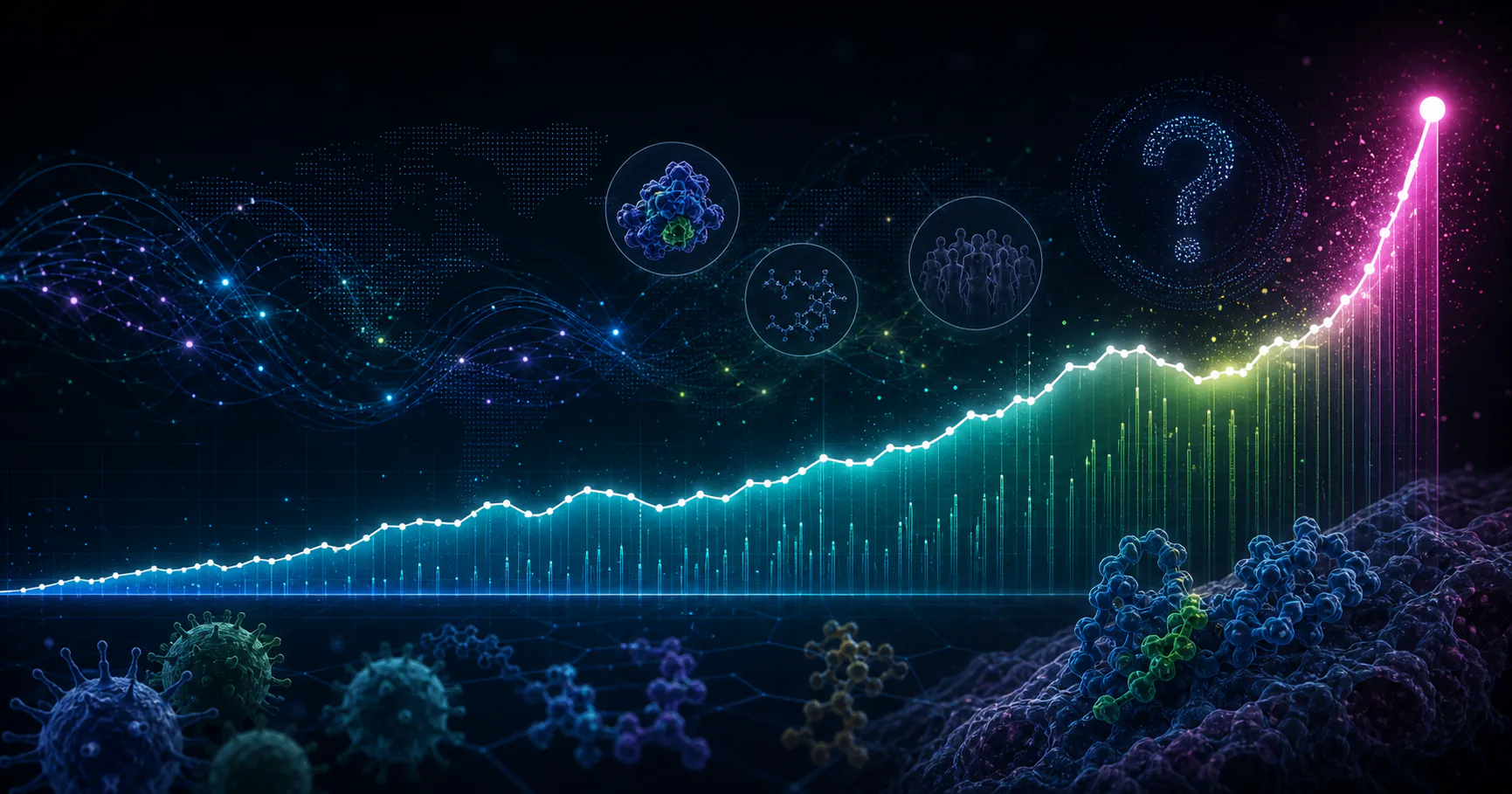
For most of the last five years, “neoantigen” was a word almost nobody outside a lab typed into a search box. That has changed. Over the past eighteen months US search interest in the term has climbed off the floor, and in early 2026 it reached the highest point in the five-year record.
What the curve shows
From mid-2021 through 2024, interest sat on a low, flat plateau — a yearly average around 6 on Google's 0–100 scale, with 37 of the first 52 weeks registering essentially zero. 2025 was the inflection: the yearly average more than doubled to about 14, and the first real spikes — into the high 40s — appeared.
Then 2026 broke out. The average for the year so far is roughly 50, and the single busiest week was that of March 15, 2026, which sets the 100 on the scale. Measured trough-to-now, the trailing-twelve-month average runs about nine times the first year's. Eight of the ten highest weeks in the entire window fall in 2026.
What it doesn't show
Two cautions before reading too much into that. First, Google Trends reports relative search interest, not volume: 100 is the busiest single week in the window, and everything else is scaled to it — it is not a count of searches, and it says nothing directly about how many papers were published or trials started.
Second, neoantigen is a niche, technical term. Its absolute search volume is small, which is exactly why the early baseline reads as a flat zero and why the week-to-week line is noisy. A rising curve here signals broadening attention — from clinicians, investors, journalists, students looking the word up — not a measure of research output.
Why it reads as signal, not noise
The shape is consistent with what this site tracks every day: a steady drumbeat of clinical readouts, commercial moves, and AI-methods papers in personalized cancer vaccines. A single isolated spike would be noise; sustained, multi-month elevation is the pattern you'd expect when a field crosses from specialist interest into wider awareness. The dense March–April 2026 cluster is where that attention concentrated.
A search curve tells you when attention arrived. It does not tell you what drove it. That is what the daily brief is for — and the throughline through 2025 and 2026 has been AI: epitope and HLA-binding prediction, immunogenicity ranking, and structure-based design pulling personalized vaccines from artisanal to industrial. If you want what's behind the curve rather than just its shape, start with today's brief or the primer.