| Dimension | Neoantigen vaccine | Neoantigen-reactive TCR-T |
|---|---|---|
| Modality | Active immunization: a shot, vector, peptide, or mRNA construct teaches the patient's immune system to raise T cells. | Adoptive cell therapy: T cells are engineered or selected outside the body and infused as the drug. |
| Antigen source | Often private patient-specific neoantigens, though shared off-the-shelf vaccines such as NOUS-209 also exist. | Usually a shared hotspot neoantigen matched to a known TCR, such as TP53 R175H in NT-175. |
| HLA restriction | Designed around each patient's HLA alleles; multi-epitope designs can span many alleles. | Strictly peptide-HLA restricted; NT-175 requires HLA-A*02:01 plus a TP53 R175H-positive tumor. |
| Manufacturing loop | Sequence tumor and normal DNA, predict neoantigens, then synthesize a peptide, vector, or mRNA vaccine. | Select target and TCR, collect T cells, edit or transduce them, expand cells, lymphodeplete, then infuse. |
| Timing | Weeks to manufacture plus weeks for priming and boosts; best when the clinical setting gives time. | Cell manufacture is complex, but the infused product supplies an immediate effector-cell dose after treatment. |
| Breadth and escape | Usually multi-target and polyclonal, which lowers the risk of losing one antigen or HLA molecule. | Often one receptor against one peptide-HLA target, which sharpens potency but raises antigen/HLA escape risk. |
| Durability | Can create immune memory if priming succeeds and tumor burden is low enough. | Depends on persistence, fitness, and exhaustion resistance of infused engineered T cells. |
| Safety burden | Usually no lymphodepletion; vaccine/adjuvant reactions and checkpoint-combination safety dominate. | Cell-therapy logistics, lymphodepletion, cytokine-release risk, neurotoxicity monitoring, and editing risks matter. |
| Clinical maturity | More mature randomized evidence exists for personalized vaccines, especially intismeran/V940 in melanoma. | Neoantigen-reactive TCR-T is earlier; NT-175 is a recruiting phase 1 study with encouraging first-cohort data. |
Keep reading: ASCO 2026: where personalized cancer vaccines stand — and the landscape around them
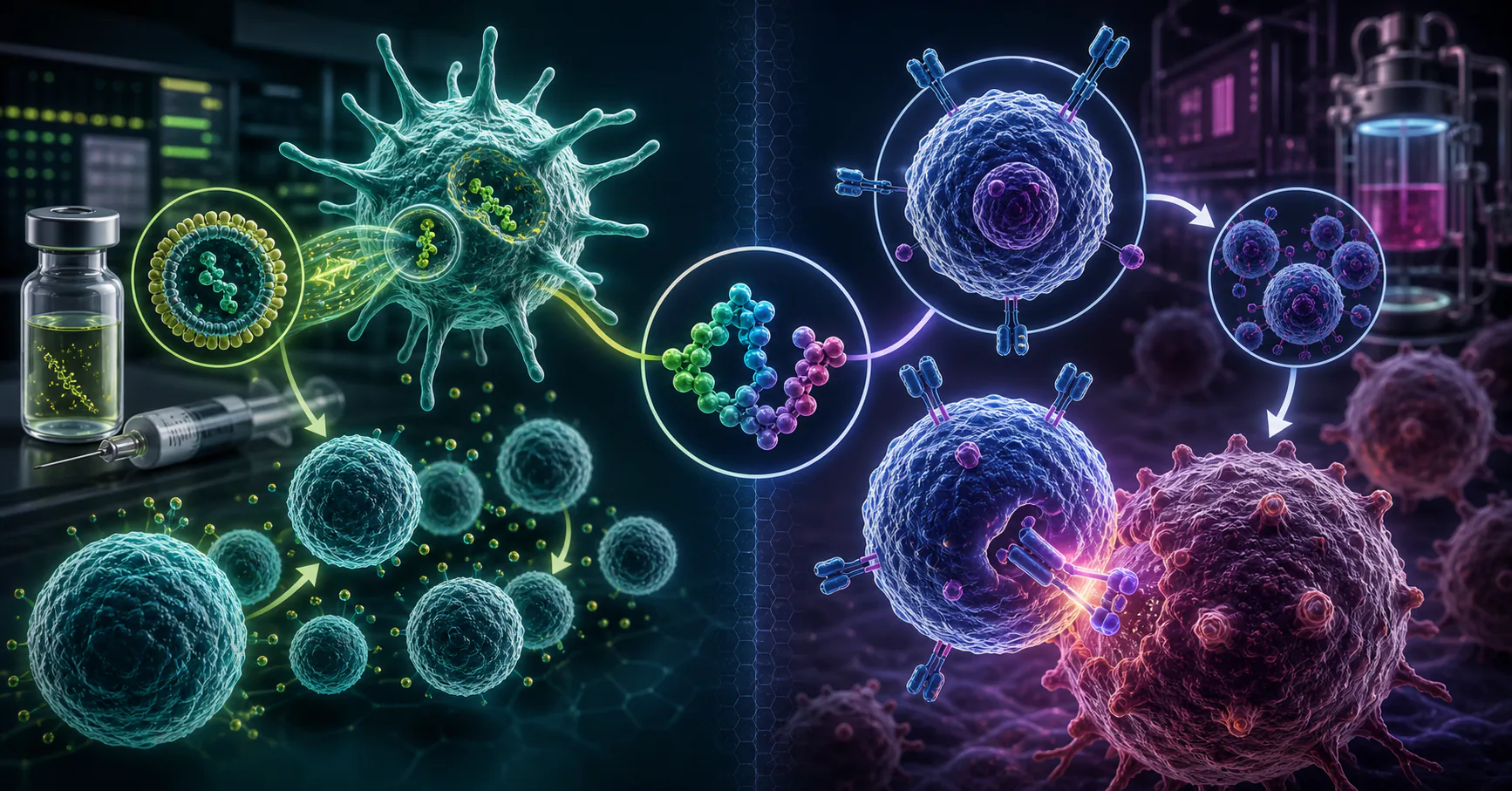
Neoantigen vaccine vs TCR-T cell therapy is not a comparison of target versus target. Both approaches start with the same question: which mutated peptide from a tumor is actually presented on HLA and recognizable by a T cell? The difference is delivery. A neoantigen vaccine tries to teach the patient's immune system to make the response; a TCR-T cell therapy manufactures T cells that already carry a receptor for the neoantigen and infuses them back into the patient.
ASCO 2026 made the distinction concrete. NT-175, an engineered TCR-T therapy for HLA-A*02:01 patients with TP53 R175H-positive advanced solid tumors, reported early objective responses and is listed on ClinicalTrials.gov as a recruiting phase 1 study. That makes it a useful foil for the more mature personalized-vaccine programs: same neoantigen logic, very different clinical and manufacturing trade-offs.
Related neoag.ai guides
- TCR modality hub — tracking engineered TCR cell therapy and T-cell-receptor biology
- T-cell receptor concept guide — what a TCR recognizes and why peptide-HLA matching matters
- TCR-pMHC models compared — AI models for predicting TCR recognition of peptide-HLA targets
- Neoantigen vaccine clinical trials tracker — live trial tracker for vaccine programs and adjacent neoantigen trials
The same upstream problem
A neoantigen vaccine and a neoantigen-reactive T-cell therapy both begin with the identical pipeline. Sequence the tumor and healthy tissue to find mutations unique to the cancer. Type the patient's HLA alleles. Predict which mutated peptides will actually be processed and displayed on those HLA molecules. Then ask the harder question: will a T cell recognize that peptide-HLA complex strongly enough to kill the tumor cell?
Everything neoag.ai tracks daily feeds both modalities: epitope and HLA-binding prediction, immunopeptidomics, immunogenicity ranking, TCR-pMHC modeling, and trial evidence. A better predictor of which neoantigen is real makes a better vaccine and a better TCR-T. The split comes only after target selection: do you induce a response inside the patient, or build the response outside the patient and infuse it?
Two ways to deliver a T cell
A vaccine is active immunization. It presents chosen neoantigens to the patient's immune system and relies on that system to raise its own T-cell response. The response can be polyclonal, often against many targets at once, and it can leave immune memory. Intismeran autogene, also known as mRNA-4157 or V940, encodes up to 34 patient-specific neoantigens per product. NOUS-209 shows the other vaccine corner: a fixed off-the-shelf vector encoding 209 shared frameshift peptides for Lynch-syndrome cancer interception.
A TCR-T is adoptive transfer. The drug is the T cell. A receptor known to recognize a peptide-HLA target is inserted into the patient's T cells, those cells are expanded, and the patient receives lymphodepletion before infusion. NT-175 is the cleanest neoantigen example: an autologous engineered T-cell therapy for TP53 R175H presented by HLA-A*02:01. Its design also knocks out TGF-beta receptor 2, an attempt to make the infused cells less vulnerable to a suppressive tumor microenvironment.
Named programs to know
| Program | Type | Target / setting | Why it matters |
|---|---|---|---|
| NT-175 | Neoantigen-reactive TCR-T | TP53 R175H in HLA-A*02:01-positive advanced solid tumors | Recruiting phase 1 study; the clearest current example of using engineered T cells against a shared hotspot neoantigen. |
| Intismeran autogene / mRNA-4157 / V940 | Personalized mRNA neoantigen vaccine | Patient-specific neoantigens in resected high-risk melanoma and phase 3 follow-on studies | The most mature randomized personalized-vaccine evidence: five-year KEYNOTE-942 follow-up reports sustained RFS and DMFS benefit. |
| NeoVax | Personalized peptide neoantigen vaccine | Patient-specific long peptides in glioblastoma and other tumors | Shows the vaccine strategy in a high-need tumor, but current GBM evidence remains early and not randomized. |
| NOUS-209 | Shared-neoantigen vaccine | Frameshift peptides in mismatch-repair-deficient / Lynch-associated tumors | Shows that shared neoantigens are not only a TCR-T idea; vaccines can use recurrent public targets too. |
Evidence maturity is not the same currency
The most common mistake is to compare a phase 1 TCR-T response rate directly against vaccine recurrence-free-survival or immune-response data. Those are different diseases, different settings, different eligibility gates, and different endpoints. Intismeran's KEYNOTE-942 data sit in resected melanoma after surgery, where recurrence-free survival and distant-metastasis-free survival are the point. NT-175 sits in advanced or metastatic solid tumors selected for both a mutation and an HLA allele, where objective response is the natural early signal.
That difference is exactly why the modalities are probably complementary rather than mutually exclusive. Vaccines are strongest when tumor burden is low and there is time to build a broad immune response. TCR-T is strongest when the target is shared, HLA-defined, and urgent enough to justify cell-therapy manufacturing and lymphodepletion.
What ASCO 2026 added
ASCO 2026 did not make neoantigen vaccines obsolete. It widened the target class. The vaccine side had more mature data: intismeran's five-year randomized melanoma update, NeoVax plus pembrolizumab in glioblastoma, and NOUS-209's shared-neoantigen prevention story. The TCR-T side had the sharper new modality signal: NT-175 reported responses against TP53 R175H, a hotspot neoantigen that has historically been hard to drug.
The right takeaway is not that one modality won. The right takeaway is that neoantigens are becoming addressable by multiple kinds of medicine: mRNA vaccines, peptide vaccines, viral vectors, engineered TCR-T cells, and eventually combinations. The common bottleneck is still the same: selecting a peptide-HLA target that is real, safe, and immunogenic.
Where each approach wins
Vaccines are best where there is time and little disease: the adjuvant setting after surgery, minimal-residual-disease interception, and prevention in genetically defined risk groups. There the patient is more likely to be immunocompetent, tumor burden is low, and the weeks a vaccine needs to prime and boost a durable response are clinically available.
TCR-T plays to the opposite conditions: established measurable disease, shared driver neoantigens, and situations where a large dose of high-avidity T cells is needed now. The price is manufacturing complexity, lymphodepletion, HLA restriction, single-target escape, and cell-therapy safety monitoring. A future regimen could use both: TCR-T for immediate tumor killing, and a vaccine to broaden or sustain the response.
Primary sources
- ClinicalTrials.gov: NT-175 / NCT05877599 — phase 1 study in HLA-A*02:01 and TP53 R175H-positive advanced solid tumors
- ASCO/JCO 2026 Abstract 2506: NT-175 — first-cohort clinical activity and safety data for NT-175
- JCO 2026: five-year intismeran autogene / pembrolizumab update — KEYNOTE-942 long-term randomized phase 2b follow-up
- ClinicalTrials.gov: V940 / mRNA-4157 / NCT03897881 — personalized mRNA neoantigen therapy plus pembrolizumab
- ASCO/JCO 2026 Abstract 2006: NeoVax in glioblastoma — personalized peptide vaccine plus pembrolizumab in newly diagnosed GBM
- Nature Medicine / PMC: NOUS-209 Lynch-syndrome vaccine — shared frameshift-peptide neoantigen vaccine data