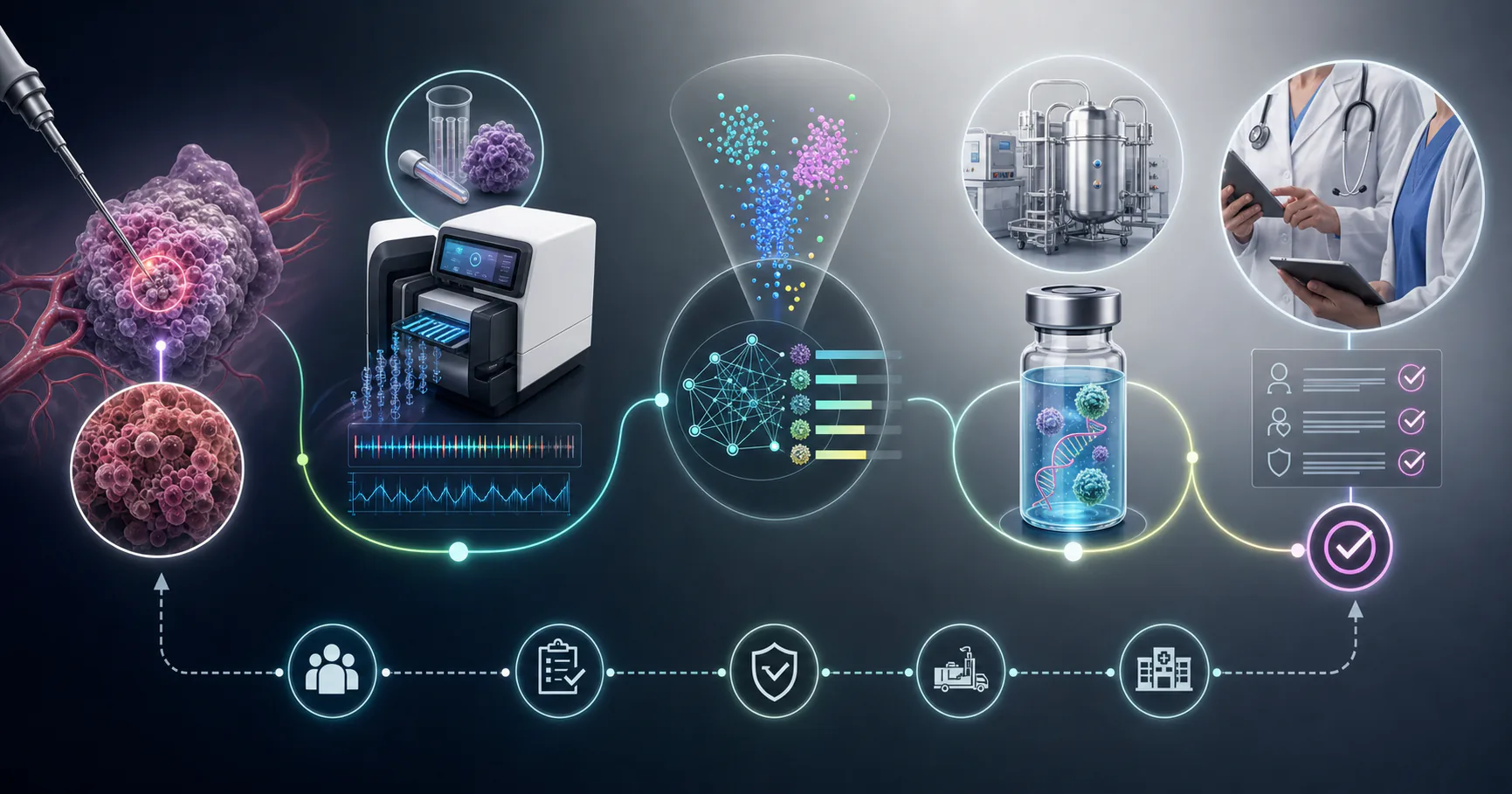
The disparity between the availability of personalized neoantigen cancer vaccines and patient access is stark, with approximately 2 million new US cancer diagnoses annually yet only ~30 patients served by existing expanded access programs. While custom-built immunotheries targeting tumor-specific mutations exist, the pathway from diagnosis to treatment remains constrained by regulatory frameworks and manufacturing timelines. Navigating the FDA’s Expanded Access (Compassionate Use) program offers a critical bridge for eligible patients, though it requires rigorous adherence to eligibility criteria and an understanding of the complex pipeline involving biopsy, sequencing, AI-driven neoantigen identification, and mRNA/peptide synthesis.
The Personalized Vaccine Pipeline
The production of personalized neoantigen vaccines follows a six-step clinical workflow beginning with the surgical removal of tumor tissue for molecular profiling. This is followed by whole exome and RNA sequencing to map the genetic code of the tumor versus healthy cells, a process taking approximately four weeks. Subsequent bioinformatics algorithms identify the most immunogenic mutations, requiring an additional four to six weeks for neoantigen identification.
Manufacturing involves the individualized synthesis of mRNA or peptide vaccines, a phase lasting 12–14 weeks, followed by administration via a series of seven doses over several months to train the immune system. Post-treatment monitoring utilizes CT scans and blood tests to measure tumor regression and T-cell receptor (TCR) activity. The total timeline from diagnosis to treatment completion spans 4–5 months, with estimated costs ranging from $100,000 to $119,000 depending on sequencing, manufacturing, and hospital administration fees.
Regulatory Pathways for Access
The FDA’s Expanded Access program provides a mechanism for patients with serious or life-threatening diseases to gain access to investigational drugs outside of clinical trials. This pathway is essential for personalized neoantigen vaccines, which are often not yet widely approved but show promise in stimulating anti-tumor immune responses. Eligibility is determined by specific diagnostic and treatment history criteria, necessitating the use of structured eligibility checkers to assess qualification for these compassionate use programs.
Computational Tools and Prioritization
Accurate neoantigen prioritization is critical for designing clinical trials and predicting treatment response. Tools such as pVACview facilitate efficient visualization and selection of neoantigens, addressing the need for robust bioinformatics workflows like ImmunoNX to support personalized vaccine trials. These computational methods are vital for identifying tumor-specific antigens that can stimulate effective immune responses, particularly in complex cases where standard phylogenetic comparisons may be insufficient.
What to Watch
Monitor the launch of digital tools designed to assist patients and clinicians in navigating personalized oncology, including eligibility checkers, cost calculators, and trial finders filtered by cancer type and stage. Additionally, track advancements in AI-enabled prognosis models and convolutional neural networks for cancer type prediction, which may refine neoantigen identification accuracy. The expansion of expanded access programs beyond the current ~30 patients served is a key indicator of scalability in the personalized immunotherapy landscape.
Sources
- Source article
- ImmunoNX: a robust bioinformatics workflow to support personal… — 2025-12-09
- AI-Enabled Lung Cancer Prognosis — 2024-02-12
- Convolutional neural network models for cancer type prediction… — 2019-06-18
- FDA: Feature Disruptive Attack — 2019-09-10
- Multi-cancer molecular signatures and their interrelationships — 2013-06-11
- New Approach for Prediction Pre-cancer via Detecting Mutated i… — 2013-10-08
- Epitope analysis for influenza vaccine design — 2004-08-23
- pVACview: an interactive visualization tool for efficient neoa… — 2024-06-11