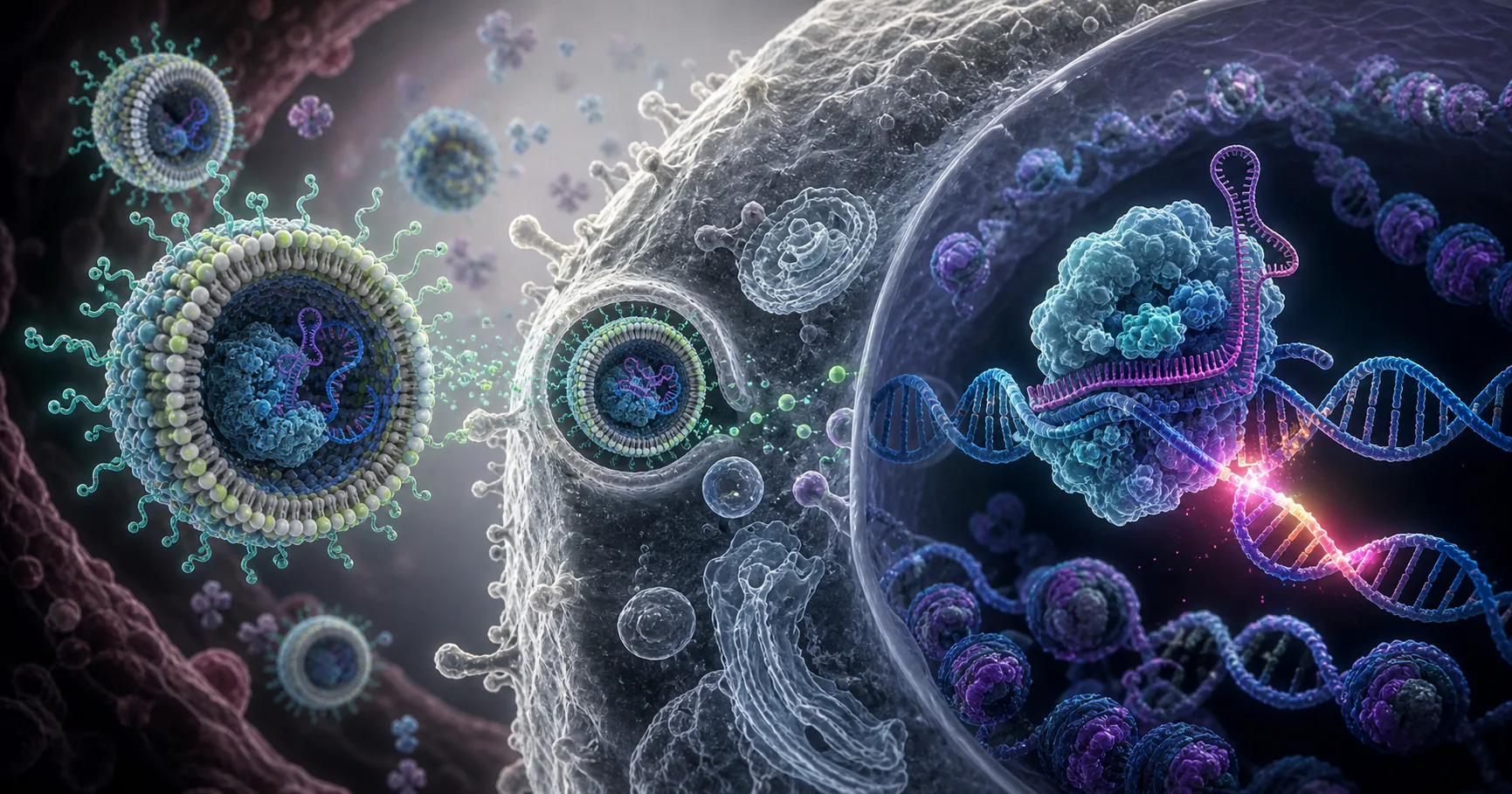
The translation of prime editing from in vitro models to clinical applications has been constrained by the inefficiency of delivering its complex three-component system—comprising a pegRNA, a reverse transcriptase, and a nicking Cas9 variant—via non-viral vectors. While lipid nanoparticles (LNPs) have established themselves as the preferred delivery mechanism for single-component RNA therapeutics, their application to prime editing has historically yielded low in vivo editing efficiencies. A recent systematic optimization platform addresses this bottleneck by refining PE-LNP formulations to enhance both in vitro and in vivo performance, marking a critical step toward viable precision medicine applications for genetic disorders and advanced cancer vaccines.
Systematic Optimization Platform
Researchers have developed a systematic prime editing LNP (PE-LNP) optimization platform designed to overcome the specific delivery challenges posed by multi-component RNA systems. This approach moves beyond trial-and-error formulation, focusing on the structural and compositional parameters that govern the encapsulation and release of the large prime editing ribonucleoprotein complexes. By establishing a rigorous framework for optimization, the study aims to standardize the production of high-efficacy PE-LNPs, ensuring consistent delivery across diverse biological contexts.
In Vivo Delivery Efficiency
The primary objective of this optimization is to achieve efficient prime editing in vivo, a feat that has remained elusive for complex three-component systems. The study demonstrates that through refined LNP engineering, it is possible to significantly enhance the delivery of prime editing machinery into target tissues. This improvement in delivery efficiency is crucial for reducing the required dose and minimizing off-target effects, thereby increasing the therapeutic index of prime editing interventions.
Precision Genome Editing
Prime editing enables precise substitutions, small insertions, and deletions at specified genomic locations without requiring double-strand breaks or donor DNA templates. The enhanced PE-LNP platform supports this high-precision capability by ensuring that the functional components reach the nucleus in sufficient quantities. This precision is particularly relevant for neoantigen research, where accurate modification of immune-related genes or tumor-specific targets can drive the development of next-generation cancer vaccines.
What to Watch
Investors and scientists should monitor the clinical translation timelines for PE-LNP formulations targeting genetic disorders, as these serve as the proof-of-concept for broader applications. Additionally, watch for integration of machine learning-guided design in subsequent LNP iterations, which may further accelerate the optimization of ionizable lipids for nucleic acid delivery. The expansion of prime editing into oncology, specifically for generating personalized neoantigens or modulating immune checkpoints, will be a key indicator of the platform's commercial viability.
Sources
- Source article
- Machine Learning-guided Lipid Nanoparticle Design for mRNA Del… — 2023-08-02
- Unraveling the Molecular Structure of Lipid Nanoparticles thro… — 2025-08-03
- Vesicle-like structure of lipid-based nanoparticles as drug de… — 2019-01-03
- Lipid Bilayer-Coated Curcumin-based Mesoporous Organosilica Na… — 2015-09-08
- Magnetic Nanoparticles for Neural Engineering — 2024-02-05
- Machine learning framework to predict the performance of lipid… — 2024-11-21
- Dynamic-eDiTor: Training-Free Text-Driven 4D Scene Editing wit… — 2025-11-30
- Small-Angle X-ray Scattering Unveils the Internal Structure of… — 2023-09-22