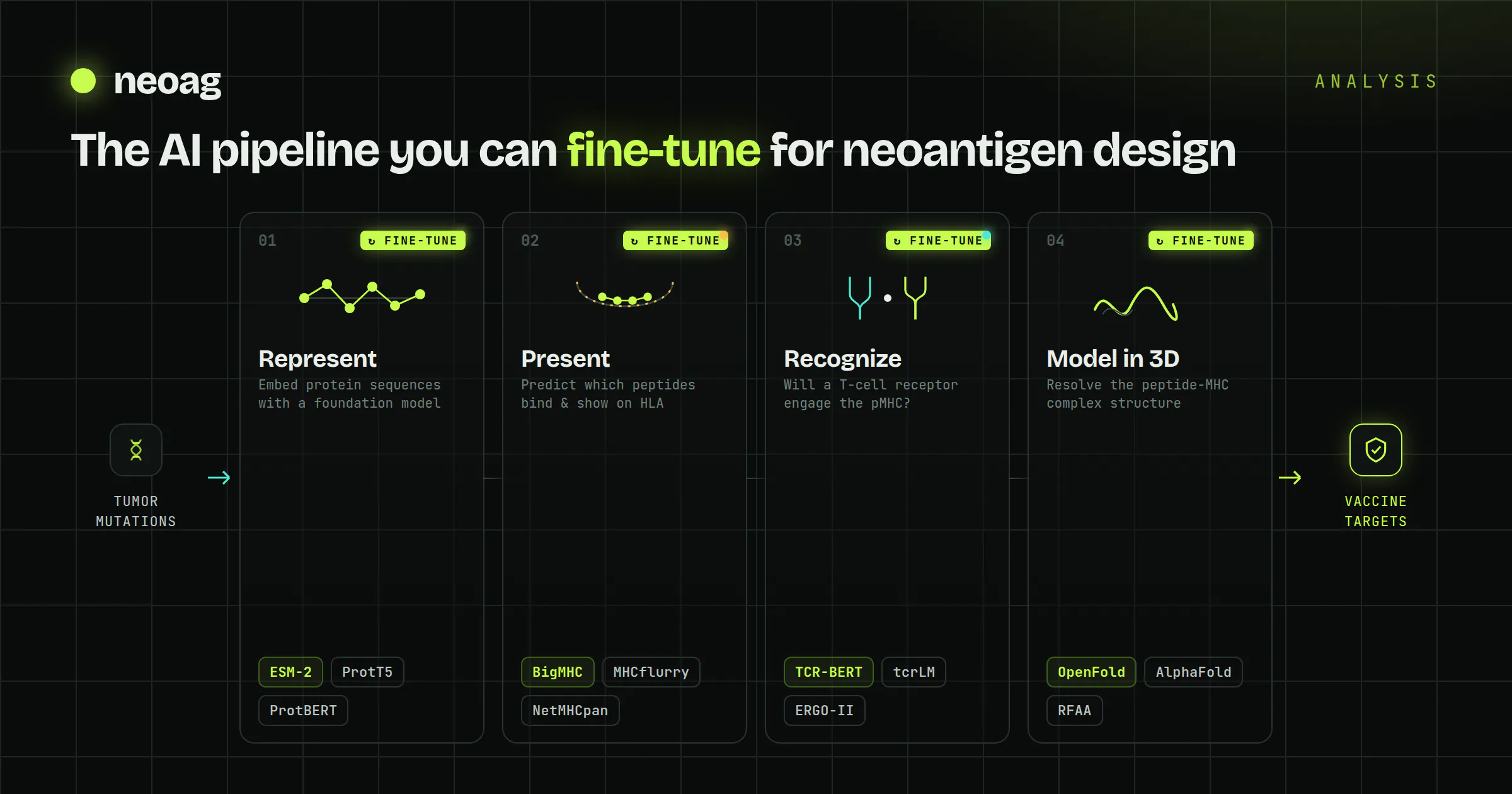
Designing a personalized cancer vaccine is really a stack of prediction problems: which mutated peptides get processed and presented on HLA, which bind a given allele, whether a T cell will recognize the resulting peptide-MHC complex, and what the whole thing looks like in three dimensions. Each of those problems now has machine-learning models built for it — and a growing number are open enough that a lab can fine-tune them on its own data rather than using them as fixed black boxes.
“Fine-tune” is doing real work in that sentence. Some of these are genuine foundation models — pretrained on millions of sequences, then adapted to a downstream immunology task with a small labelled set. Others ship as trained predictors you can retrain but not readily adapt, and a few are powerful but locked down by license. Here is a working map, grouped by the problem each one solves, with the honest version of how tunable each really is.
Protein language models
These are the closest thing the field has to a true foundation layer: transformers pretrained with masked-language modelling on hundreds of millions of protein sequences, producing embeddings that transfer to almost any downstream task. Fine-tuned for HLA binding, a protein language model has already been shown to beat the long-standing specialist tools — in a 2023 benchmark a fine-tuned ESM-2 outscored NetMHCpan-4.1 on MHC-I binding.
- ESM-2 — Meta's protein language model; fine-tuned for MHC-I binding it beat NetMHCpan-4.1 in a 2023 benchmark. Its sibling ESMFold predicts structure but isn't itself the fine-tuning target.
- ProtT5 — RostLab's T5 protein language model; its embeddings transfer into peptide-HLA and immunogenicity models.
- ProtBERT — RostLab's BERT protein language model; a common encoder fine-tuned for epitope and TCR–epitope tasks.
- ESM-3 / ESM C — EvolutionaryScale's newer open, generative protein language models; open weights meant for embedding and fine-tuning.
MHC presentation & immunogenicity
This is the core neoantigen-selection step: of the peptides a tumor could display, which are actually presented on HLA, and of those, which provoke a response. The standout for fine-tuning is BigMHC, the textbook transfer-learning story — pretrained on mass-spec presentation data, then fine-tuned onto immune-response data to predict neoepitope immunogenicity. Others are open enough to retrain; the field standard, NetMHCpan, is not.
- BigMHC — Johns Hopkins; the canonical transfer-learning case — pretrained on presentation, fine-tuned for neoepitope immunogenicity. Ships a transfer-learning script light enough to run on a CPU.
- MHCflurry 2.0 — OpenVax; open-source pan-allele MHC-I presentation predictor with a documented training pipeline you can retrain on your own peptides.
- TransPHLA — A transformer for peptide–HLA binding with in-repo training code; pairs with a peptide optimizer aimed at vaccine design.
- NetMHCpan-4.1 — DTU; the field-standard pan-allele binding/presentation predictor. Retrainable in principle, but distributed as fixed pre-trained weights — not user-fine-tunable out of the box.
TCR–pMHC recognition
Presentation isn't recognition. The hardest open problem is whether a T-cell receptor will actually engage a given peptide-MHC complex — the difference between a neoantigen that is merely displayed and one that works. Two models here follow the clean pretrain-then-fine-tune recipe; the rest are trained end-to-end and can be retrained but not adapted.
- TCR-BERT — Stanford / Zou lab; BERT pretrained on TCR sequences, then fine-tuned for antigen binding. Ships a fine-tuning script and Hugging Face weights.
- tcrLM — A masked-language model pretrained on 100M+ TCR sequences and fine-tuned for TCR–neoantigen specificity; the repo includes both pretrain and fine-tune scripts.
- ERGO-II — Bar-Ilan; deep TCR–peptide binding predictor that folds in CDR3α, V/J genes and MHC. Trained end-to-end — retrain rather than fine-tune.
- pMTnet Omni — UT Southwestern; pan-MHC, cross-species TCR–pMHC predictor built on frozen ESM embeddings — transfer learning inside, but shipped as a predictor/web server.
Structure-based models
The newest frontier is modelling the peptide-MHC (and TCR–pMHC) complex in three dimensions. Here fine-tunability and licensing diverge sharply: the open reproductions are fully trainable, AlphaFold2's weights have been fine-tuned for peptide-MHC by outside groups, and the most capable newest models are the most locked down.
- OpenFold — OpenFold Consortium; an Apache-2.0, fully trainable reproduction of AlphaFold2 — the most genuinely fine-tunable structure model on this list.
- AlphaFold2 — DeepMind; its CC-BY weights have been fine-tuned for peptide-MHC structure by outside groups (Motmaen 2023; MHC-Fine 2024), in practice via OpenFold.
- AlphaFold3 — DeepMind; powerful for complexes, but its terms explicitly forbid using it to train derived structure predictors — effectively not fine-tunable.
- RoseTTAFold All-Atom — Baker Lab; all-atom biomolecular modelling. The code is permissive but the weights and dependencies are non-commercial, with no official fine-tuning recipe.
How to read this list
Three cautions. First, “open” and “fine-tunable” are not the same as “licensed for your use” — several of the structure models are non-commercial only, which matters the moment a vaccine program turns commercial. Second, a model you can retrain isn't automatically one you should: the foundation models earn their keep precisely because a few hundred labelled examples can adapt them, where a from-scratch retrain needs far more data. Third, none of these is the whole pipeline — real neoantigen discovery chains presentation, binding, immunogenicity and increasingly structure together, and the gains now come from the handoffs between them as much as from any single model.
If the terms here are unfamiliar, the primer and glossary explain the underlying biology; for what's moving week to week across exactly these methods, start with today's brief.