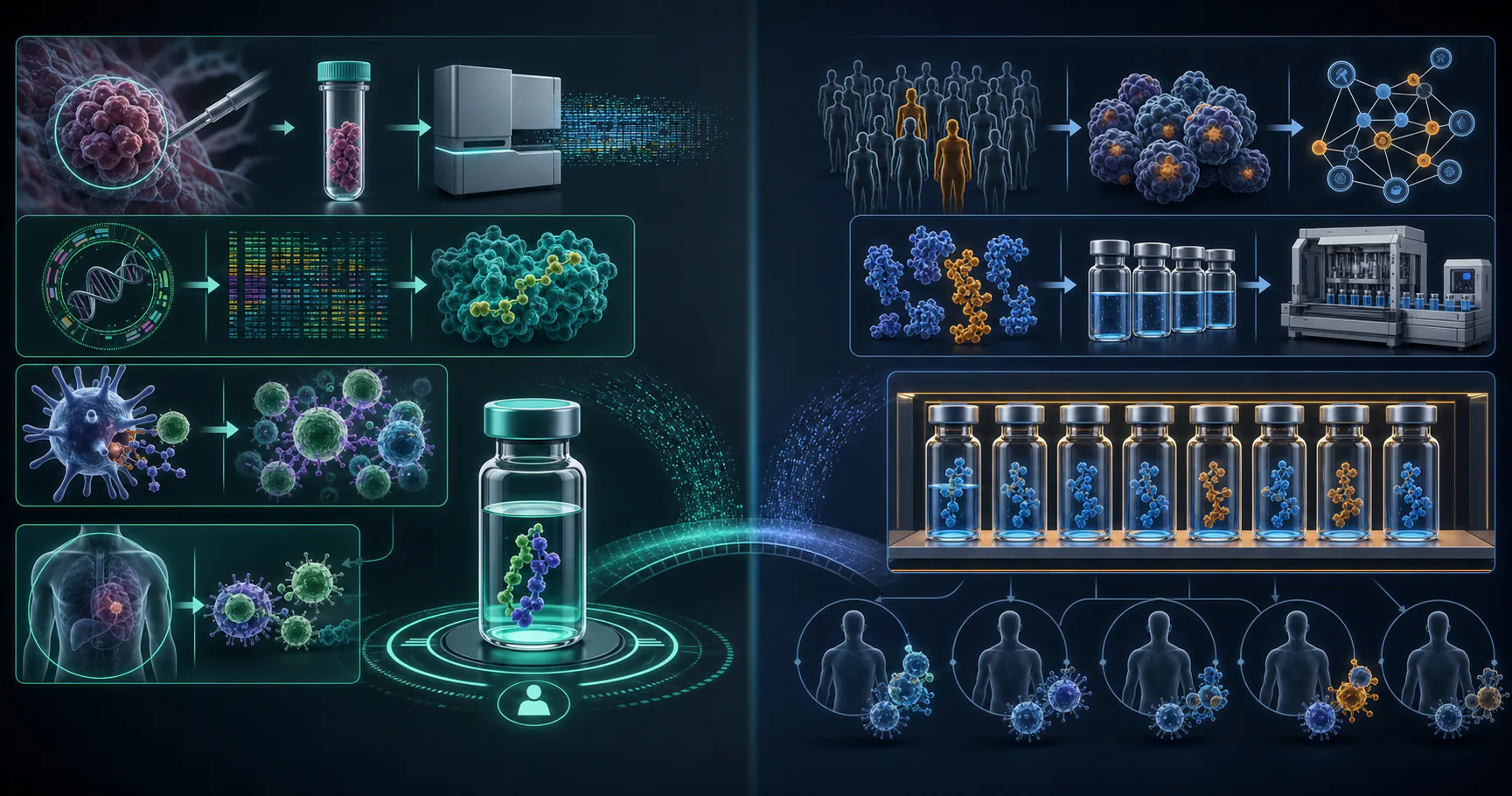
Every neoantigen vaccine starts from the same premise: tumors carry mutations that produce proteins the body has never seen, and those neoantigens are, in principle, ideal targets — present on cancer cells and absent from healthy tissue. The strategic fork is in how you get to them. One path sequences each patient's tumor and manufactures a vaccine to order. The other pre-manufactures against neoantigens that recur across many patients' tumors. Neither is obviously correct; they make different bets and carry different tradeoffs in cost, turnaround, scale, breadth of applicability and whether the vaccine can be used for prevention rather than only treatment. This is a two-approaches story, not a horse race.
The personalized approach
Individualized neoantigen vaccines sequence the tumor, predict which mutations yield neoantigens likely to be presented and recognized, and encode a patient-specific set into the product — typically mRNA. Moderna and Merck's intismeran autogene (mRNA-4157/V940) encodes up to 34 neoantigens selected from each patient's tumor mutational signature; in the phase 2b KEYNOTE-942 trial in resected high-risk melanoma, the vaccine plus pembrolizumab met its primary recurrence-free-survival endpoint, and the companies reported a sustained ~49% reduction in risk of recurrence or death versus pembrolizumab alone in long-term follow-up. The program has moved into phase 3 in adjuvant melanoma and other settings. BioNTech's autogene cevumeran (BNT122) takes the same individualized approach in resected pancreatic cancer, where phase 1 follow-up reported persistent vaccine-induced T cells associated with longer recurrence-free survival in responders; a roughly 260-patient phase 2 trial is underway.
The strength is precision: the vaccine targets the mutations that specific tumor actually presents, including private mutations no other patient shares. The challenges are structural. Each dose requires its own sequencing, prediction and manufacturing run, which adds turnaround time between biopsy and dosing, raises per-patient cost, and constrains how many patients can be served in parallel. There is also an open regulatory question: a product that is unique to each patient does not fit neatly into the framework built for mass-produced drugs, and how agencies handle N-of-1 manufacturing and release at scale is still being worked out.
The off-the-shelf approach
Shared- or public-neoantigen vaccines target mutations that appear in many patients, so a single product can be manufactured in advance and given to anyone eligible. Two target classes dominate. The first is recurrent oncogenic hotspots, above all KRAS: Elicio's ELI-002 is an off-the-shelf amphiphile vaccine against common mutant-KRAS variants, with phase 2 AMPLIFY-7P data reporting mKRAS-specific T-cell responses in the large majority of evaluable patients. Gritstone's SLATE platform encoded shared neoantigens across KRAS, TP53 and others, and Moderna's mRNA-5671 targeted KRAS variants — both illustrate the approach, though each has since seen program changes, a reminder that the strategy is not derisked.
The second class is frameshift neoantigens in mismatch-repair-deficient (dMMR) and microsatellite-instable (MSI) tumors, where insertion-deletion errors generate shared aberrant peptides. Nouscom's NOUS-209 delivers 209 such shared frameshift peptides via a viral-vector prime-boost. Its distinguishing feature is the use case: a phase 1b/2 trial in Lynch syndrome carriers — people with an inherited predisposition but no active cancer — was published in Nature Medicine and reported durable T-cell responses across many neoantigens plus a reduced frequency of pre-cancerous lesions at one year. That is cancer interception, a prevention angle essentially unavailable to the personalized approach, which needs an existing tumor to sequence. The tradeoff is breadth: an off-the-shelf vaccine only helps patients whose tumors carry the targeted mutations, and tumors can also lose or fail to present those specific targets.
| Dimension | Personalized / individualized | Off-the-shelf / shared-neoantigen |
|---|---|---|
| Targets | Patient-specific mutations from the sequenced tumor, including private ones | Recurrent / public neoantigens shared across patients (e.g. KRAS hotspots, MSI frameshift peptides) |
| Manufacturing | A bespoke run per patient | Batch-manufactured once, stored, drawn down as needed |
| Turnaround | Biopsy-to-dose lag for sequencing, prediction and manufacture | Available on demand; no per-patient production step |
| Cost / scale | Higher per-patient cost; parallel capacity is a constraint | Lower unit cost and easier scale, in principle |
| Applicability | Any tumor with mutations, regardless of how rare | Only patients whose tumors carry the targeted mutations |
| Prevention use | Limited — needs an existing tumor to sequence | Feasible — can immunize high-risk carriers before cancer arises |
| Lead programs | Intismeran autogene (Moderna/Merck), autogene cevumeran (BioNTech) | NOUS-209 (Nouscom), ELI-002 (Elicio); SLATE (Gritstone), mRNA-5671 (Moderna) earlier |
Keep reading: Moderna and Merck Personalized Cancer Vaccine Clinical Trial Results Analysis
Where AI fits each
Both approaches lean on computational target selection, but at different altitudes. Personalized vaccines are an AI-per-patient problem: from a tumor's mutations, models must predict which peptides will be processed, bind that patient's specific HLA alleles, and be recognized by T cells — then rank a shortlist to encode, all on a clock because turnaround is part of the product. The accuracy of epitope-prediction and presentation models directly shapes how good each bespoke vaccine is.
Off-the-shelf vaccines pose a population-level selection problem: which shared neoantigens recur often enough, across enough HLA backgrounds, to be worth pre-manufacturing for a broad eligible group. Here AI works over cohorts and reference datasets rather than a single tumor, optimizing for coverage and immunogenicity across a population. The same modeling toolkit — presentation prediction, HLA binding, immunogenicity scoring — serves both, but one asks 'what should this patient's vaccine contain?' and the other asks 'what should be in the catalog?'
The likely outcome: coexistence
The most plausible read is that these approaches occupy different niches rather than one displacing the other. Personalized vaccines fit settings where tumors are mutation-rich and individually variable and where the clinical value of covering private mutations justifies the bespoke pipeline — adjuvant melanoma and pancreatic cancer are the leading test cases. Off-the-shelf vaccines fit settings defined by a dominant shared driver (KRAS-mutant tumors) or a shared mutational mechanism (dMMR/MSI), and they uniquely open the door to interception in high-risk populations such as Lynch syndrome carriers, where there is no tumor to personalize against.
It is worth being precise about what is and is not established: the personalized lead programs have positive controlled efficacy signals but are still reading out pivotal trials, while several shared-target programs report strong immunogenicity with clinical-efficacy and prevention endpoints earlier in maturity. Different endpoints, different stages. The field-level signal is genuinely encouraging across both branches; the patient-level question of which approach wins where will be settled trial by trial, not by argument.