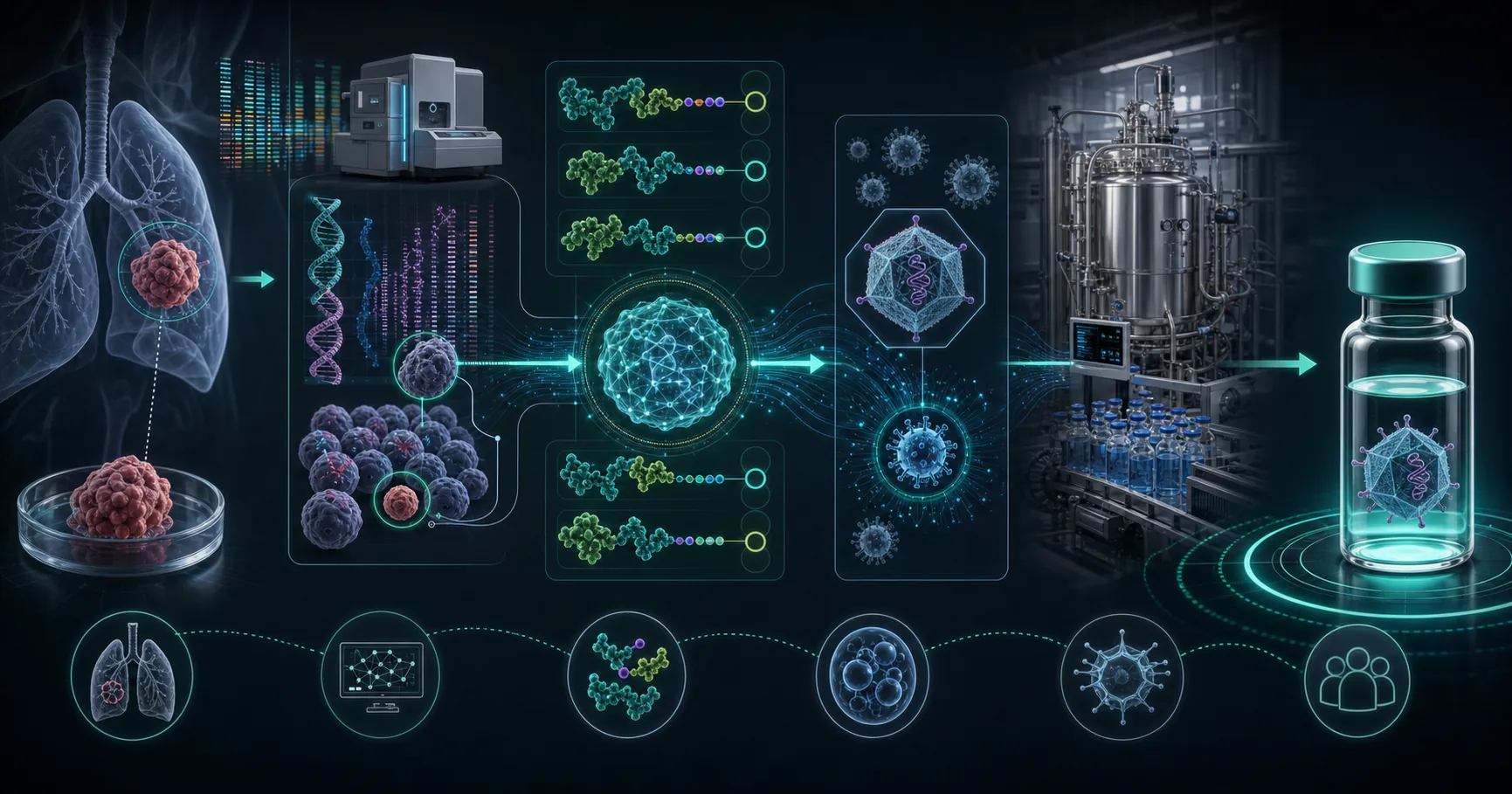
On June 22, 2026, Transgene (Euronext Paris: TNG) announced the start of a randomized Phase 1 trial of TG4070, an individualized neoantigen therapeutic vaccine (INTV) given with nivolumab in the adjuvant treatment of resected non-small cell lung cancer (NSCLC). On the surface this reads as a routine pipeline expansion — a second indication for the myvac® platform after head and neck cancer. The more consequential story is what changed under the hood. TG4070 is the first Transgene vaccine whose neoantigen selection is driven entirely by SNIPER, the company's own in-house AI engine, rather than by NEC's prediction system that designed its predecessor TG4050. It is also the first to be built on a scalable cell-line manufacturing process that replaces the chicken-embryo-fibroblast (CEF) method the platform has relied on since inception.
Both shifts target the two structural weaknesses that have dogged personalized cancer vaccines: the bioinformatics bottleneck of picking the right handful of mutations to vaccinate against, and the manufacturing bottleneck of producing a bespoke product fast enough and cheaply enough to matter at scale. Transgene is making this move into the most competitive arena in the field — adjuvant NSCLC, where Moderna and Merck's mRNA-4157 is already in global Phase 3 — and it is doing so with a fundamentally different modality: a Modified Vaccinia Ankara (MVA) viral vector rather than lipid-nanoparticle mRNA. TG4070 is therefore a clean test of two propositions at once: that a small European biotech can internalize frontier neoantigen AI, and that the viral-vector approach remains clinically and commercially viable against the mRNA incumbents.
The timing is deliberate. TG4050, the platform's lead asset, has produced eye-catching early data in head and neck cancer — 100% disease-free survival at two years in its Phase 1 cohort — and is now in the randomized Phase 2 readout path. By launching TG4070 now, Transgene is converting a single promising asset into a platform thesis precisely when investors are asking whether INTV is a one-tumor curiosity or a generalizable franchise.
SNIPER Brings AI In-House
SNIPER — Specific Neoantigen Identification and Prediction of Elicited Response — is Transgene's proprietary scoring framework that integrates multiple computational models to rank candidate mutations by predicted immunogenicity. Per the company, it weighs tumor-specific expression and antigen presentation to select the small set of neoantigens worth encoding into each patient's vaccine. That this is now fully internal is the headline methodological change. TG4050 was designed using NEC's neoantigen prediction system — an AI built on graph-based relational learning and more than two decades of proprietary immune data — under a long-running Transgene-NEC collaboration. With SNIPER, Transgene controls the prediction layer end to end, which matters for iteration speed, IP, and the economics of running the same engine across many tumor types.
The prediction problem SNIPER addresses is genuinely hard and under-appreciated by non-specialists. A resected tumor may carry hundreds of nonsynonymous mutations, but only a minority generate peptides that are actually processed, presented on the patient's specific HLA alleles, and capable of eliciting a functional T cell response. Vaccinating against the wrong epitopes wastes the limited cargo capacity of the vector and the limited window before recurrence. The TG4050 experience offers a real-world calibration of what good prediction buys: each individualized vaccine encoded up to 30 predicted neoantigens, and in the Phase 1 immunogenicity analysis, 73% of 15 evaluable patients mounted neoantigen-specific T cell responses, described as polyepitopic and polyclonal with durable cytotoxic CD8+ phenotypes detectable up to a year after treatment.
For neoag's audience, the load-bearing claim to watch is whether SNIPER's in-house predictions match or beat the NEC-designed benchmark TG4050 set. Transgene reports that preclinical work supported comparable performance, but the only verdict that counts is clinical: the rate and breadth of induced T cell responses in TG4070 patients versus the 73% seen with TG4050. That is the cleanest available proxy for whether internalizing the AI was an upgrade or merely a cost and control play.
From Eggs to Cell Lines
The second change is manufacturing, and it may matter more commercially than the AI. MVA, the vaccine vector, has traditionally been propagated in primary chicken embryo fibroblasts — a CEF process that is labor-intensive, hard to automate, and awkward to scale. TG4070 moves to a cell-line-based process that Transgene describes as more efficient, more automated, and faster, with preclinical data showing performance comparable to the CEF-derived product. Crucially, the company frames this as preserving continuity with existing clinical data while removing the scalability ceiling — a deliberate effort to avoid resetting the regulatory clock on years of MVA experience.
Manufacturing turnaround is the silent killer of personalized vaccines in the adjuvant setting, where the therapeutic window opens the moment a tumor is resected and narrows with every week before recurrence. A faster, transposable cell-line process shortens vein-to-vaccine time and, just as importantly, makes it plausible to run the platform across multiple tumor types simultaneously without each indication requiring its own bespoke production campaign. Transgene signaled the strategic weight it places here by stating it intends to move TG4050 itself onto cell-line manufacturing for potential future head-and-neck trials — i.e., the new process is meant to become the platform default, not a TG4070-only experiment.
This is where the viral-vector approach must answer the mRNA challenge most directly. Lipid-nanoparticle mRNA manufacturing is highly templated — swap the sequence, keep the process — which is a structural advantage for personalization. By re-engineering MVA production toward an automated cell-line workflow, Transgene is implicitly conceding that manufacturing agility, not just immunogenicity, is the axis on which INTV platforms will compete.
Adjuvant NSCLC, A Hard Arena
TG4070's trial design is conservative and well-targeted: a randomized Phase 1 in patients with resected NSCLC who have received neoadjuvant nivolumab plus chemotherapy, with TG4070 added to continued nivolumab, and safety and tolerability as the primary endpoints (EU trial number EUCT 2025-520946-31-00; screening to begin within weeks). The choice of the post-neoadjuvant adjuvant niche is clinically astute. Despite complete resection, a large fraction of NSCLC patients relapse — recurrence estimates range broadly from roughly a quarter to over two-thirds depending on stage — and even with neoadjuvant chemo-immunotherapy, the CheckMate 816 regimen that defines current standard of care achieved a pathologic complete response in only about 24% of patients. The majority who do not clear their tumor are exactly the high-risk, minimal-residual-disease population a neoantigen vaccine is designed to mop up.
The competitive context is unforgiving. Moderna and Merck's mRNA-4157 (intismeran autogene / V940) plus pembrolizumab is already in the global Phase 3 INTerpath-002 trial (NCT06077760) in resected NSCLC, riding momentum from melanoma: in the Phase 2b KEYNOTE-942 study the combination cut the risk of recurrence or death by 49% versus pembrolizumab alone, with a 2.5-year recurrence-free survival of 74.8% versus 55.6%. Transgene enters years behind on this indication and at a far earlier phase. Its bet is differentiation rather than speed — that an MVA vector delivering a polyepitopic payload induces a qualitatively different, more cytotoxic T cell response than mRNA, and that the platform's manufacturing and AI overhaul lets it run cheaply across many tumors.
Investors should keep the TG4050 efficacy signal in proportion. The 100% two-year disease-free survival is striking and was sustained at a median 30-month follow-up across 32 evaluable HPV-negative HNSCC patients (NCT04183166), but the Phase 1 was small and its design — immediate versus deferred vaccination — was not powered as a controlled efficacy comparison. The data remain a medRxiv preprint under peer review. It is a strong hypothesis-generating result, not proof; the randomized Phase 2 exists precisely to convert it into evidence.
What to Watch
Near-term, three concrete signals. First, the June 29, 2026 conference call (3 p.m. CET / 9 a.m. ET) should disclose TG4070 trial size, randomization scheme, the immunogenicity endpoints, and the vein-to-vaccine timeline the new cell-line process delivers — the latter being the single most informative number on whether manufacturing was genuinely fixed. Second, TG4050's randomized Phase 2 cadence is the platform's real catalyst chain: randomization completed in Q4 2025, first Phase 2 immunogenicity data expected H2 2026, efficacy data around Q4 2027, and topline in Q1 2028 — any disease-free-survival separation versus control in 2027 is the result that validates or breaks the entire INTV thesis.
Third, watch for the first head-to-head methodological tell: whether TG4070 patients match TG4050's ~73% neoantigen-specific T cell response rate and 30-epitope payload now that SNIPER, not NEC, is choosing the targets — the cleanest readout on whether internalizing the AI preserved predictive accuracy. Also track peer-reviewed publication of the TG4050 Phase 1 (currently a medRxiv preprint), confirmation that cell-line manufacturing carries over to future TG4050 trials without a regulatory reset, and any read-through from Moderna/Merck's INTerpath-002 NSCLC Phase 3, whose outcome will set the bar — and the reimbursement narrative — that Transgene's viral-vector approach must eventually clear.
Sources
- Source article
- Transgene Expands myvac® into NSCLC with TG4070 (GlobeNewswire) — 2026
- Transgene Publishes Phase I Data Supporting TG4050's Potential… — 2026
- TG4050 Delivers Positive Randomized Phase I Data (GlobeNewswire) — 2025
- Transgene expands platform with trial of INTV in NSCLC (BioTue… — 2026
- Transgene & NEC: High Accuracy of AI-based Neoantigen Predicti… — Transgene-NEC AI collaboration
- Phase I Trial of Neoantigen Vaccine Shows 100% DFS Rate in HNS… — 2025
- Moderna & Merck: 3-Year mRNA-4157 (V940) + KEYTRUDA Melanoma D… — KEYNOTE-942 / INTerpath context
- Merck & Moderna Initiate Phase III of mRNA-4157 + Keytruda in … — INTerpath-002 NSCLC
- Addition of Nivolumab to Neoadjuvant Chemotherapy in NSCLC: Ch… — adjuvant/neoadjuvant NSCLC standard of care