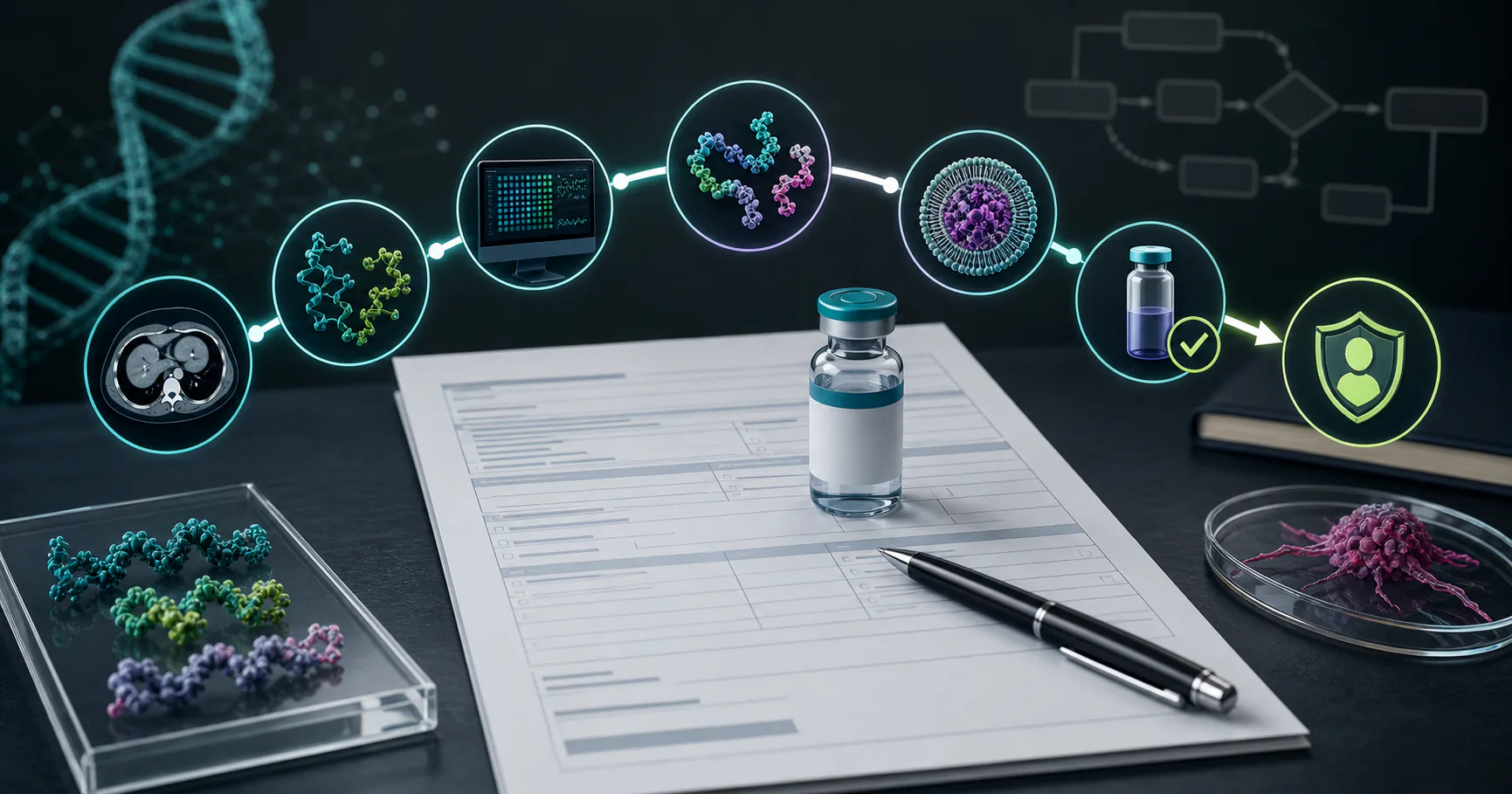
A personalized neoantigen cancer vaccine is, by construction, an investigational drug — none is broadly FDA-approved, and access today runs almost entirely through clinical trials. But trials exist to test a hypothesis, not to treat everyone: they enforce strict inclusion and exclusion criteria, and a patient whose disease is too advanced, who has brain metastases, whose organ function sits just below a threshold, or who has already had an exclusionary line of therapy is routinely turned away. For that patient, there is one remaining legal route to an individualized vaccine — the FDA's expanded access pathway, widely called "compassionate use," requested through a Single Patient Investigational New Drug application filed on FDA Form 3926.
This piece is a workflow, not a recommendation. The site is written by an engineer, not a physician or an attorney, and nothing here is medical or legal advice — every step below is something a licensed sponsor-investigator and a hospital's review board must own. The point is to make the FDA Form 3926 process legible: what the form is, who files it, what dossier it carries, how long it takes, what it costs, and where it sits in the regulatory picture this site has already mapped for the N-of-1 cancer vaccine.
What FDA Form 3926 actually is
Form FDA 3926 is the single-page application a physician uses to request expanded access to an investigational drug outside a clinical trial, for one individual patient who has a serious or immediately life-threatening condition and no comparable or satisfactory alternative therapy. The FDA created it specifically to collapse the paperwork burden: the agency accepts a completed Form FDA 3926 in place of the full Investigational New Drug submission otherwise required under 21 CFR §§ 312.23, 312.305(b), and 312.310(b). Check the box in Field 10.a and sign it, and the form also serves as a request under § 312.10 to waive the additional IND requirements that would normally apply.
Two facts about Form 3926 govern everything downstream. First, only a licensed physician can submit it — the patient cannot file their own expanded-access IND. The physician becomes the Sponsor-Investigator and assumes the legal and regulatory responsibility for the treatment. Second, the form is mostly a frame around two attachments that do the real work: a Clinical Rationale written by that physician, and a Letter of Authorization from the drug's manufacturer. The form is the envelope; the dossier inside it is the argument.
- Form FDA 3926 — instructions and current form (FDA) — The form itself, plus field-by-field instructions including Field 10.a (the IND-requirement waiver)
- FDA final guidance — Individual Patient Expanded Access Applications: Form FDA 3926 — How the agency intends Form 3926 to satisfy the 21 CFR 312 submission requirements
Why a personalized vaccine fits the Single Patient IND
Expanded access has several flavors. An intermediate-size population IND lets a small defined group reach a drug; a treatment IND covers larger populations. But a personalized neoantigen vaccine is manufactured from the genetic code of one tumor in one person — it is, almost definitionally, an N-of-1 product. So the relevant vehicle is the Individual Patient IND, the narrowest form of expanded access, and Form FDA 3926 is the instrument built for exactly that request. The analogy the FDA itself has worked through is the single-patient IND used for custom antisense oligonucleotides like milasen: a drug designed, made, and dosed for one identified patient.
It is worth being precise about why this is the bottleneck rather than the trial route. The vaccine is investigational because it has not cleared a randomized phase 3 with a hard clinical endpoint — the same reason general approval of the modality is not expected before the end of the decade. Until then, expanded access via Form 3926 is the only door for a patient outside a trial, which is why the form, obscure as it is, is the load-bearing piece of the entire access story. For how the agency reconciles approving a different molecule for every patient at all, see the companion piece on regulating an N-of-1 cancer vaccine.
- How the FDA regulates an N-of-1 cancer vaccine — The regulatory companion: how a medicine that is unique per patient is allowed to exist at all
- 21 CFR Part 312 — expanded access to investigational drugs (§§ 312.300–312.320) — The statutory criteria a Form 3926 application must satisfy
The dossier Form 3926 carries: the clinical rationale
The heart of a Form FDA 3926 submission is the Clinical Rationale, a narrative the Sponsor-Investigator authors to show the request satisfies 21 CFR Part 312. For a personalized vaccine, where no efficacy data for the specific not-yet-manufactured product can exist, the rationale has to carry the whole argument. In practice it must establish four things:
Severity — that the patient faces a serious or immediately life-threatening condition, stated concretely (the diagnosis, stage, and a historical survival figure). Exhaustion of alternatives — that there is no comparable or satisfactory alternative therapy, documenting that standard NCCN-guideline lines have been used or are inappropriate, and that the patient is ineligible for currently enrolling trials, with the specific exclusion criteria named. Benefit-versus-risk — that the potential benefit justifies the risks and those risks are not unreasonable given the disease; because the individual payload is unique, the argument leans on the platform — that the underlying AI prediction models and GMP manufacturing process have shown safety and the generation of targeted T-cell responses in phase 1 trials of similar tumors. And the treatment protocol — the exact dosing schedule, route of administration, and the monitoring plan for immune-related adverse events.
This is also where the AI content of the therapy meets the regulator. The rationale describes a product whose targets were selected by machine-learning models that rank neoantigens by predicted HLA binding and immunogenicity — the same prediction stack this site tracks daily — but the FDA is not asked to approve the algorithm. It is asked to judge that the platform is sound and the per-patient risk is acceptable. The model picks the targets; the dossier argues the platform is safe enough to try.
The other attachment: the Letter of Authorization
The application cannot proceed without the manufacturer's permission. A biotech's prediction algorithms, synthesis chemistry, and lipid-nanoparticle or adjuvant formulations are trade secrets, held in confidential Master Files with the FDA. So the physician must obtain a Letter of Authorization (LOA) from the manufacturer — a legal document that grants the FDA permission to reference those Master Files when assessing the platform's safety. The LOA does not describe the patient's specific vaccine; it authorizes the agency to cross-reference the manufacturer's existing IND and Master File in support of this one Single Patient IND.
Securing that authorization is a gating step in its own right, and it is the reason oncologists are told to contact the drug company early. The FDA's own guidance for physicians frames the LOA as a prerequisite, and the Oncology Center of Excellence runs Project Facilitate specifically to help providers obtain it and navigate the rest of the request. The manufacturer's agreement — to supply the drug at all, and on what cost-recovery terms — is the precondition before FDA review even becomes relevant.
- FDA — For Physicians: How to Request Single Patient Expanded Access — The step-by-step the sponsor-investigator follows, including obtaining the LOA
- FDA Oncology Center of Excellence — Project Facilitate (1-240-402-0004) — OCE's single point of contact to help oncologists assemble an expanded-access request
The clocks: 30 days, emergencies, and the IRB
Once Form FDA 3926 is submitted, the default timeline is fixed: the drug may be shipped and treatment may begin 30 days after the FDA receives the application, unless the agency notifies the physician sooner that they may proceed. If the FDA does not place a clinical hold within that window, the application is effectively safe to proceed. For a custom vaccine this 30-day review runs concurrently with the months of manufacturing, so in practice it is rarely the rate-limiting step.
Emergencies follow a separate, faster track. In an emergency the request can be made to the FDA by telephone or other rapid means, and authorization to ship and treat can be granted verbally — sometimes within 24 hours. The written Form 3926 and the LOA must then follow within 15 working days of that authorization. There is a parallel accommodation on the ethics side: when an investigational drug must be used in an emergency and Institutional Review Board approval cannot be obtained beforehand, treatment may begin without prior IRB approval provided the IRB is notified within 5 working days.
The IRB is the second mandatory gate, separate from the FDA. A board that complies with federal IRB requirements must take responsibility for initial and continuing review of the treatment use, and Form 3926 requires the physician to certify this. The IRB's focus is the Informed Consent Document: it will insist the consent strip away jargon and state plainly that the therapy is experimental and unapproved, that the AI used to select targets is investigational, that there is no guarantee of benefit, and that stimulating the immune system carries a real risk of autoimmune toxicity. Both gates — FDA and IRB — must clear before the synthesized vaccine can be legally administered.
The operational timeline behind the form
The paperwork is only one strand. Building the actual product runs about four to five months from biopsy to first dose, and the Form 3926 review nests inside it rather than adding to it. The sequence, roughly:
| Workflow phase | What happens | Typical duration |
|---|---|---|
| Genomic sequencing | Whole-exome sequencing of tumor and matched healthy tissue; RNA expression profiling | ~4 weeks |
| Computational design | AI-driven neoantigen identification, HLA-binding simulation, immunogenicity ranking, payload selection | 4–6 weeks |
| GMP manufacturing | Custom synthesis of the mRNA or peptide construct, purification, lot-release QC testing | 12–14 weeks |
| FDA review (Form 3926) | Individual Patient IND review — runs concurrently with manufacturing, not after it | Up to 30 days |
Keep reading: How FDA regulates personalized N-of-1 cancer vaccines
The cost — and why insurance won't touch it
The hardest barrier is financial, and it is structural rather than incidental. Because personalized neoantigen vaccines remain investigational with no FDA approval, there are no established billing codes for them, and U.S. health insurers effectively universally deny coverage for a therapy obtained through expanded access. The patient bears the full cost — biopsy, high-throughput sequencing, AI processing, GMP manufacturing, and clinical administration — which typically lands somewhere around $100,000 to $119,000, and is generally required in escrow before manufacturing begins.
That turns access into a wealth filter. Families pursuing the pathway routinely liquidate assets, borrow against home equity, draw down retirement accounts, or crowdfund. The structural gap is stark: by one estimate on the order of 10,000–20,000 patients a year might be eligible, while existing expanded-access vaccine programs serve only tens. Form FDA 3926 removes the regulatory barrier to a personalized vaccine; it does nothing about the financial one, which is where most of the real-world filtering happens.
Who helps you file it
Most oncologists in high-volume clinics have never filed a Single Patient IND and are wary of the administrative and liability load, which is why third-party navigators have grown up around the pathway. On the FDA side, the Oncology Center of Excellence's Project Facilitate is a dedicated line for oncology providers seeking expanded access, and the Reagan-Udall Foundation's Expanded Access Navigator is a neutral clearinghouse of program information. On the private side, nonprofit consortia such as the Jaime Leandro Foundation for Therapeutic Cancer Vaccines, working with operators like ImmunaPath, exist specifically to run self-pay compassionate-use programs for personalized vaccines and to handle the coordination between oncologist, manufacturer, FDA, and the precision laboratories.
For the patient advocate, the practical lesson is that the request is a coalition, not a form. The leverage is to bring the physician a package — a willing manufacturer with an LOA, a navigator handling the logistics, and funding already in place — rather than a request to investigate "AI treatments," which a clinician will rightly discount. Framed inside the federal regulatory vocabulary — a Single Patient IND on Form FDA 3926 under 21 CFR Part 312 — it becomes a concrete ask a sponsor-investigator can evaluate.
- Reagan-Udall Foundation — Expanded Access Navigator — Independent clearinghouse of expanded-access program information and company policies
- Jaime Leandro Foundation for Therapeutic Cancer Vaccines — Nonprofit consortium running self-pay compassionate-use vaccine programs
A reality check
Two cautions belong on any honest account of this pathway. The first is evidentiary: phase 1 data for personalized vaccines consistently show safety and immune activation, but have not yet proven a broad survival benefit in advanced, refractory disease. Expanded access buys a sophisticated, well-reasoned attempt — not a known cure — and the informed consent says exactly that. The second is systemic: the programs that subsidize compassionate use depend on a research pipeline that is itself volatile. Reported cuts to NCI cancer-research funding and the termination of federal mRNA-vaccine development grants in 2025 directly pressure the biotech and academic capacity that makes these vaccines available at all, which can narrow an already microscopic bottleneck.
None of that changes what Form FDA 3926 is: the narrow, real, and surprisingly navigable regulatory door to a personalized cancer vaccine for a patient who has run out of trials. The science of picking the neoantigens — the part this site follows day to day — is racing ahead. Whether a given patient can actually receive the result still comes down to a physician willing to be the sponsor-investigator, a manufacturer willing to supply and authorize, an IRB, roughly $100,000, and one signed form. For how the vaccine on the other side of that form is designed, see the computational blueprint; for the broader approval question, the N-of-1 regulatory guide.
- A computational blueprint for personalized cancer vaccines — What the vaccine reached via Form 3926 actually is, phase by phase
- Personalized vs off-the-shelf neoantigen vaccines — Why an individualized product is an N-of-1 — and why that forces the Single Patient IND route